
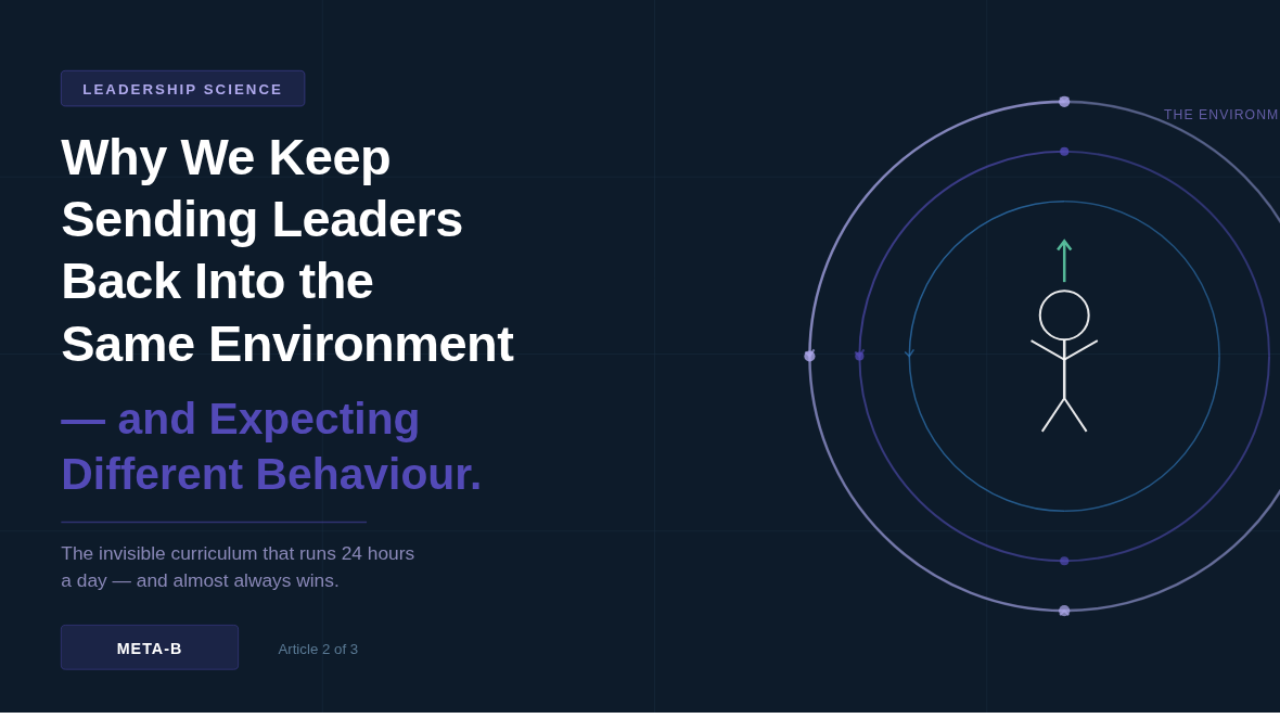
Why We Keep Sending Leaders Back Into the Same Environment and Expecting Different Behaviour
Jun 16, 2026There's a pattern that every HR and L&D leader recognises.
You invest in a leadership program. Some leaders visibly change. Then, over the following weeks, the change quietly erodes. They start sounding like they used to. Making decisions the way they always did. Handling conflict the way they always handled conflict.
The common conclusion is that the training didn't work.
The more accurate conclusion is that the environment won.
The environment is a programme too — and it runs 24 hours a day
Every organisation has an invisible leadership curriculum. It is transmitted not through workshops but through what gets rewarded and what gets ignored. Through how the senior team behaves under pressure. Through which leadership behaviours are tolerated, modelled, and promoted.
This invisible curriculum runs constantly. And when it conflicts with what a leader learned in a development program, it almost always wins. Not because leaders lack commitment, but because the environmental signals are more frequent, more immediate, and more consequential than anything that happened in a training room.
Sending a leader through a development program without addressing the environment they return to is like training someone to swim and then dropping them back into a current running the opposite direction.
|
The evidence: 75% of organisations have updated leadership programs and increased spending — and are not seeing results (Gartner, 2024) Trust in managers dropped from 46% to 29% in just two years, 2022 to 2024 80% of U.S. workers report working in a toxic environment — up from 67% in 2024 Toxic workplace culture is 10.4x more likely to drive employees out than low pay 74% of HR leaders say managers are not equipped to lead change despite years of investment (Gartner, 2024) |
These numbers are not evidence that leaders cannot change. They are evidence that programs are being designed as though the environment does not exist.
The pressure test that most programs skip
There is a specific moment that determines whether a development program has worked or not. It is not the end-of-program feedback form. It is not the 30-day check-in.
It is the first time a leader faces real pressure after the program ends.
A difficult stakeholder. A missed target. A direct report who challenges their authority in front of the team. A restructuring announcement that lands badly.
In that moment, the leader has a choice — except it rarely feels like a choice. The automatic response fires first. And if the old response was encoded deeply and the new response was only lightly practised, the old one wins.
The environment makes this worse, because it often rewards the old behaviour. The leader who shuts down dissent gets through the meeting faster. The one who avoids the difficult conversation preserves short-term harmony. The environment is not neutral — it actively reinforces the very patterns that development programs are trying to shift.
What needs to happen before a program can hold
This is where most organisations are sequencing incorrectly.
They design the program first and assume the environment will accommodate it. What actually needs to happen first is an honest assessment of three things: whether the senior team models the behaviours being developed, whether the organisation rewards those behaviours, and whether the environment is safe enough for a leader to persist with new behaviour through the initial period when it is unsteady.
New behaviour is neurologically fragile before it consolidates. A leader trying to hold a coaching-style conversation for the first time — under real pressure, with real stakes — is doing so with a response that is not yet encoded as automatic. If the environment punishes the attempt, the leader will revert. Not because they gave up, but because the environment provided a stronger signal than the program did.
The leader's nervous system is the first line of defence
There is a dimension to this that most development programs miss entirely — and it is the most important one.
The reason environmental pressure is so effective at eroding new behaviour is not just that the environment is powerful. It is that the leader's own nervous system has not been developed to withstand it.
When a leader returns from a development program into a demanding, high-pressure, politically complex environment, their nervous system faces a choice: stay regulated and access the new, lightly encoded behaviour, or activate a threat response and revert to the deeply encoded automatic one. Without deliberate work on nervous system regulation — on what we might call the physiological capacity to remain sovereign under pressure — the environment wins almost every time.
The environment does not just undermine new behaviour from the outside. It activates the neurological conditions that make reverting inevitable — unless the leader's nervous system has been built to hold its ground.
This is the work that almost no program does. Not because it is not understood, but because it requires a fundamentally different design philosophy: one that treats the leader's internal physiological state not as a personal matter, but as a direct performance variable that determines whether development investment holds or evaporates.
A leader who has developed this capacity — the trained ability to remain regulated, grounded, and clear under the specific pressures their organisation produces — does not need ideal conditions to sustain new behaviour. They can hold the new response precisely when the environment is pushing hardest against it.
That is the difference between development that lasts and development that requires quiet conditions to function.
What this means for how you design development
None of this means leadership programs are futile in imperfect environments. It means they need to be designed with environmental reality at the centre — not as an afterthought.
It means building in explicit work on the specific pressures leaders will face when they leave the room. It means developing the leader's capacity to sustain new behaviour not just in ideal conditions but in the actual conditions of their organisation. And it means treating physiological resilience under pressure as a core developmental outcome — because without it, even excellently designed programs hit a nervous system that cannot hold the new response when conditions get hard.
